
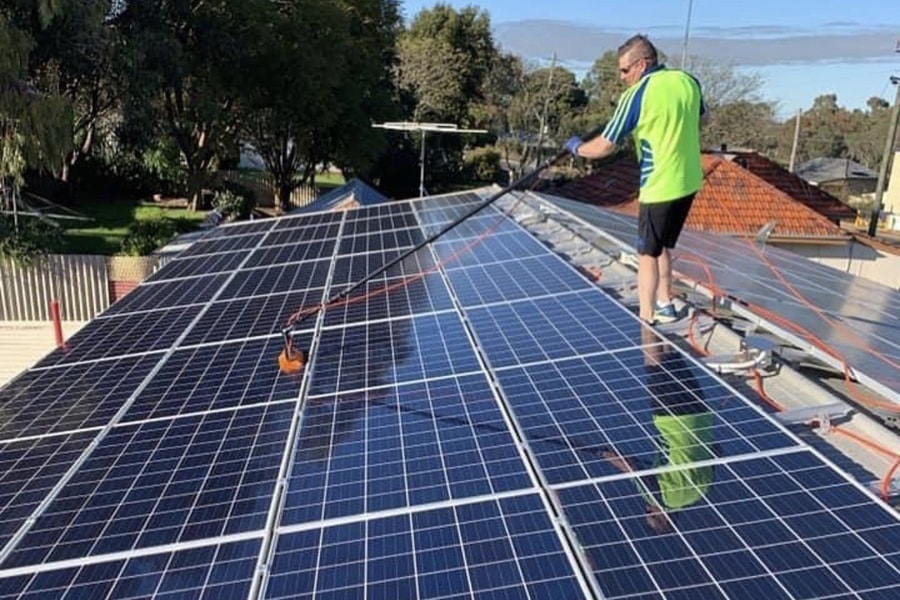
Clean panels make the most of the sun, but cleaning them the wrong way can scratch the glass, void your warranty or put you in danger on the roof. This guide covers when solar panels need cleaning, how to do it safely and when to leave it to a specialist.
Key points
- In the UK, rain keeps most panels reasonably clean – many only need cleaning once a year or less.
- Bird droppings, lichen and heavy grime are the main reasons to clean.
- Clean from the ground with soft brushes and pure or lukewarm water – never climb onto the roof.
- If droppings keep coming back, the cause is usually pigeons nesting under the panels.
Do solar panels need cleaning in the UK?
Often less than people think. Panels are tilted and the UK gets plenty of rain, so light dust usually washes off on its own. Cleaning becomes worthwhile when you can see a build-up that rain isn’t shifting, for example:
- bird droppings, which dry hard and shade individual cells
- moss or lichen creeping in from the edges of the frame
- grime from nearby roads, farms, building work or trees
- panels with a shallow tilt, where dirt collects along the bottom edge
A good test is your generation figures. If output on sunny days is noticeably lower than the same month last year, and the panels look dirty, a clean is worth considering.
How to clean solar panels safely
- Check your warranty and manual. Some manufacturers specify cleaning methods or products.
- Stay on the ground. Working on a roof is dangerous. Use a water-fed telescopic pole with a soft brush instead of a ladder.
- Pick a cool time. Clean early morning or evening, or on an overcast day. Cold water on hot glass can stress it, and water dries too fast in sunshine and leaves marks.
- Use soft tools only. A soft-bristle brush or sponge. No scourers, pressure washers or stiff brushes.
- Use plain water. Purified (deionised) water dries spot-free. If you must use soap, use a tiny amount of mild, non-abrasive soap and rinse well.
- Rinse gently. A gentle hose spray or the water-fed pole – never a jet aimed under the frame or at connections.
- Check your output. Compare your generation over the following sunny days.
What not to do
- Don’t walk or kneel on panels.
- Don’t use pressure washers, harsh chemicals, bleach or abrasive pads.
- Don’t spray water under the panels or into junction boxes.
- Don’t scrape dried droppings – soak them first and brush gently.
When to use a professional cleaner
If your panels are high up, on a steep roof or heavily soiled, use a specialist solar panel cleaner with water-fed pole equipment and insurance. Please note: Pigeon Solar Solution no longer offers solar panel cleaning – we specialise in pigeon proofing and bird control.
Droppings keep coming back? Check under the panels
If your panels are regularly covered in droppings, cleaning only treats the symptom. The usual cause is pigeons nesting in the gap underneath the array. Signs include cooing or scratching on the roof, twigs sticking out from under the panels and droppings on windowsills below.
Fitting mesh around the panels stops birds getting underneath and keeps the panels much cleaner afterwards. Find out how our solar panel pigeon proofing works and what it costs.
Frequently asked questions
How often should solar panels be cleaned?
For most UK homes, once a year or only when you can see a build-up is enough. Panels near farms, busy roads or trees, or with nesting birds nearby, may need it more often.
Does rain clean solar panels?
Rain removes light dust well, but it won’t shift dried bird droppings, lichen or greasy grime.
Can I use washing-up liquid?
A very small amount of mild soap is usually fine, but it can leave a film if not rinsed properly. Plain or purified water is safest – check your manufacturer’s guidance first.